Reinforcement learning in production
Reinforcement learning running as a live product capability
REINFORCEMENT LEARNING AT SCALE
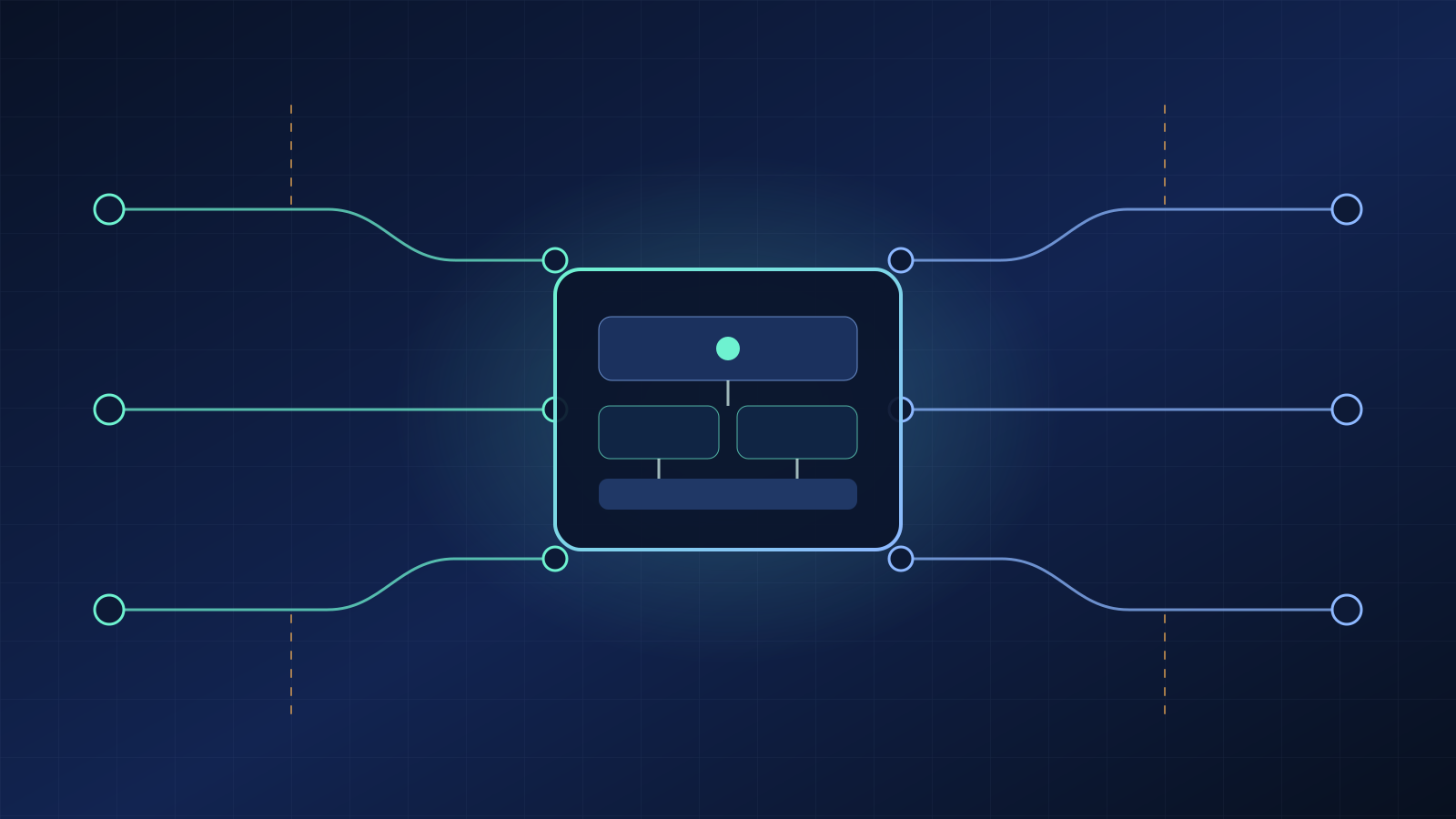
Reinforcement learning in production
Reinforcement learning running as a live product capability
TB-scale daily data pipelines
First-party customer data prepared for reliable AI decisioning
Hundreds of millions of daily decisions
Decision orchestration across downstream systems and channels
NewBizLabs helped architect, build, and scale an AI decisioning platform powered by reinforcement learning. In practice, it meant learning from live signals to make hyperpersonalized decisions and outcomes for individual users at scale. It was designed for real-world enterprise use cases and had to scale reliably across customer environments, channels, and large audiences.
"AI decisioning only becomes valuable when reinforcement learning is backed by a platform that can be operated, scaled, and trusted in production."
Platform perspective
Building the platform meant creating a product that could experiment continuously under real production constraints. It had to support enterprise use cases from the start rather than being optimized for one specific use case.
That depended on working with first-party customer data drawn from heterogeneous sources that varied widely across customer environments. The platform had to account for customer-specific requirements in how those integrations were designed and how signals were prepared for AI decisioning.
Scale made the problem materially harder. The platform had to operate reliably across downstream systems and channels while serving large audiences and very demanding enterprise workloads.
Operationalizing that workload required more than a strong model. Reliability, repeatability, and platform-level discipline had to be built in from the start so the product could hold up under large-scale, complex enterprise use.
NewBizLabs helped architect, build, and run the platform foundations needed to make AI decisioning work reliably in production. That included the runtime, the data and pipeline layer, orchestration for decisioning workloads, and the activation paths required to move decisions into downstream systems.
The platform was designed to work across different customer data architectures rather than assume one fixed data model. That made it possible to turn first-party customer data into usable signals and support a broad range of enterprise use cases without forcing every deployment into the same operating pattern.
Operational discipline was built into the platform itself. Reliability, observability, isolation, and cost-awareness were treated as platform properties so the product could keep running under real enterprise load and continue experimenting safely in production.
0TB+
of data processed daily through the platform
Hundreds of millions
of AI decisions produced and orchestrated daily
Production-grade
reliability, idempotency, and isolation built into the platform
The result was an AI decisioning platform that could support real enterprise use cases rather than a narrow ML workflow built for one specific use case.
It processed more than 100TB of data daily through the platform and produced and orchestrated hundreds of millions of AI decisions every day, while remaining reliable across downstream systems, channels, and customer environments.
That made reinforcement learning practical in production: teams could operate the platform continuously, extend it across use cases, and trust it under live enterprise load.
The platform had to make AI decisioning work under real production constraints: heterogeneous first-party data, customer-specific integration requirements, large daily workloads, and continuous operation across customer environments.
The platform had to operationalize reinforcement learning workloads for real-world use cases, not controlled experiments. It needed to learn from heterogeneous first-party customer data, account for customer-specific integration requirements, and stay useful across channels and large audiences.
At the same time, the workload had to hold up under very large-scale data and decision volume, which made reliability and operational discipline just as important as model quality.
NewBizLabs helped build the platform on GCP with Kubernetes as the core runtime, BigQuery as the warehouse backbone for decisioning workloads, Airflow for orchestration, and Spark for large-scale processing. The platform used multi-tenant patterns with logical isolation per customer, including customer-specific object storage and BigQuery dataset boundaries, alongside task-level isolation in Kubernetes workloads.
Robust, idempotent pipelines and repeatable execution paths were treated as platform requirements. That made it possible to operate AI decisioning reliably across downstream systems and channels while keeping the product observable, supportable, and scalable under enterprise load.
"The differentiator was not a single model or use case. It was a platform foundation that could support enterprise AI decisioning under real-world constraints."
Platform perspective

Privacy-first ESG platform engagement combining regulatory rigor, scalable AI platform architecture, and human-supervised agentic workflows for audit-ready GHG accounting.
Read more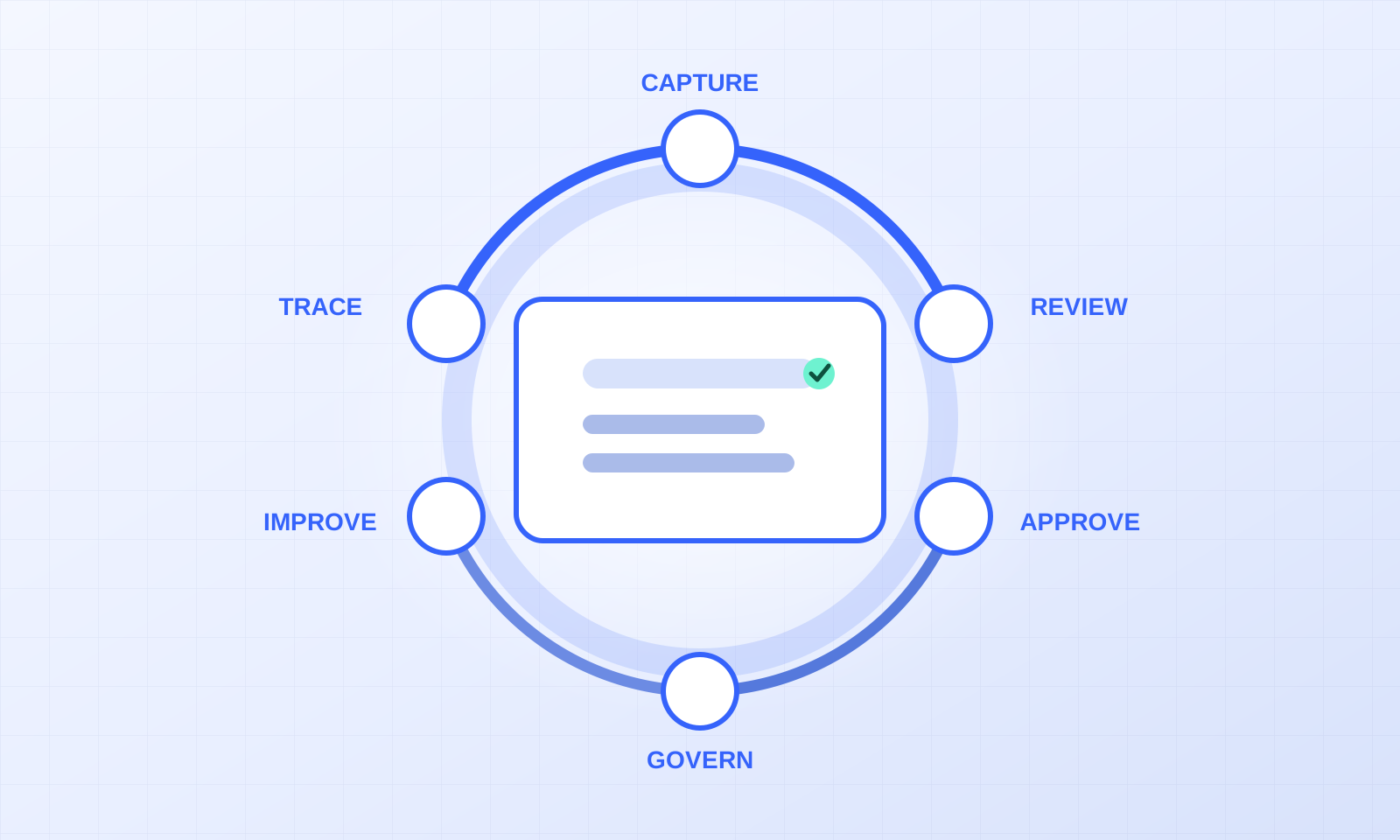
NewBizLabs helps product and engineering organizations scale with a stronger compliance posture and less delivery drag by designing security, privacy, auditability, and AI governance into the way teams work.
Read moreTell us where you need leverage, from strategy and architecture to production and adoption. We'll help define the right next steps.
Contact us