Compliance-ready context
Current standards and policy logic built into execution
HUMAN-SUPERVISED AGENTIC ESG PLATFORM

Compliance-ready context
Current standards and policy logic built into execution
Organization-specific modeling
Workflows shaped around real operating practices
Traceable human-supervised execution
Explainable automation with review and feedback loops
Privacy-first ESG platform engagement for a foundational platform that combined regulatory context, scalable AI platform architecture, and human-supervised agentic workflows for GHG accounting. The platform was designed to improve compliance-sensitive execution while remaining flexible enough to model organization-specific operating reality and support multiple downstream customer contexts.
"Compliance-sensitive workflows become more reliable when platform design combines current standards context, explainable execution, and expert supervision."
Platform perspective
Standards interpretation was changing faster than manual workflows could reliably absorb, including updates tied to NAICS-aligned classification logic and broader national, regional, and international ESG requirements.
Experts were spending too much time on repetitive tagging and validation work, which limited their capacity to focus on higher-value review, exception handling, and policy judgment.
Off-the-shelf carbon-accounting tooling did not leave enough room to represent company-specific operating practices accurately or package those capabilities into a product that could support multiple customer environments.
Auditability suffered whenever source context, automated reasoning, and human supervision were not preserved across the full execution chain.
NewBizLabs designed and delivered the platform across workflow design, platform architecture, and expert oversight. Subject-matter experts were repositioned from manual processors to supervisors and feedback providers, while workflows were restructured around context construction, classification, emissions analysis, artifact generation, and validation.
At the platform layer, the architecture combined a knowledge-driven context subsystem, model-gateway orchestration, explainable trace capture, and human-supervised validation. Tooling selection and platform engineering judgment were part of the value: the system needed to stay rigorous enough for compliance-sensitive use while remaining operable at scale.
The platform was built to reflect organization-specific operating reality instead of forcing reporting into a rigid generic template. A privacy-first vector-backed knowledge layer supported company context and standards content, giving teams a reusable foundation that could be embedded into the client’s broader product and sold across different customer contexts.
>0%
reduction in manual validation effort
Faster
compliance update cycles with current standards context
Auditable
clear traceability across workflow execution and human review
Compliance update cycles tightened because the platform kept standards context current and made classification logic easier to adapt as requirements evolved.
Manual validation effort dropped materially, freeing expert capacity for review, oversight, and strategic work instead of repetitive tagging and reconciliation.
Reporting became more factual and more defensible because outputs reflected organization-specific context rather than generic assumptions, with clearer audit trails from source input to final result.
The engagement produced a reusable foundational platform that could support multiple customer contexts without sacrificing rigor, privacy, or explainability.
This platform had to do more than automate a workflow. It needed to make Scope 3 estimation from unstructured inputs more reliable, more explainable, and more adaptable to organization-specific operating context.
The hard problem was not carbon accounting in the abstract. It was estimating Scope 3 emissions from fragmented business artifacts where the relevant signals were often unstructured, incomplete, and highly dependent on operating context. That made factor selection, retrieval quality, and validation design central to whether the output would be useful in a compliance-sensitive workflow.
The final platform did not come from a single predetermined pattern. We explored multiple approaches for factor recommendation, workflow grounding, and contextual retrieval, using Amazon Science's Parakeet work as the main reference point for recommendation logic and ranking strategy. From there, the architecture was extended through further iteration to better handle organization-specific context, productization requirements, and auditability expectations.
The landed design used Qdrant as the primary vector database and combined exact matching, embedding search, and agentic interfaces into a hybrid retrieval layer. That retrieval stack fed a context-construction subsystem that blended company context with standards and policy content before passing requests into classification, emissions analysis, artifact generation, and human-supervised validation.
Across the execution chain, the platform preserved explainable trace capture, reviewer input, and exception handling so every recommendation could be inspected, challenged, and improved without breaking the flow of the workflow.
That architecture made the platform materially better at handling Scope 3 ambiguity while keeping the resulting recommendations contextual, reviewable, and operationally useful. It also created a reusable foundational platform that could support multiple customer environments without reducing the work to generic carbon-accounting templates.
"The strongest ESG platforms do not force teams into generic tooling. They create a rigorous, reusable foundation that adapts to organization-specific operating reality and downstream customer needs."
Platform perspective
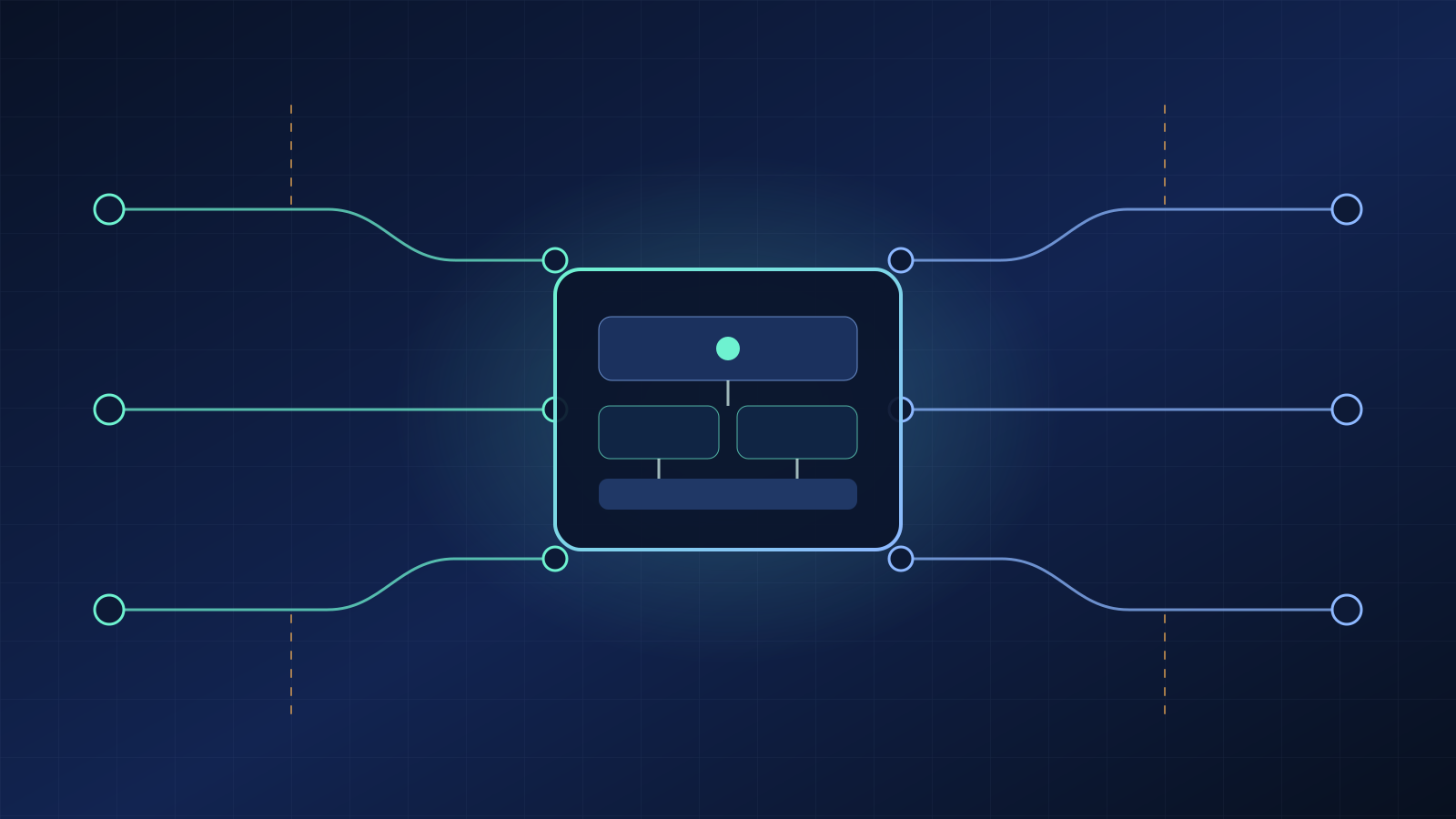
AI decisioning platform powered by reinforcement learning and built for real enterprise use cases.
Read more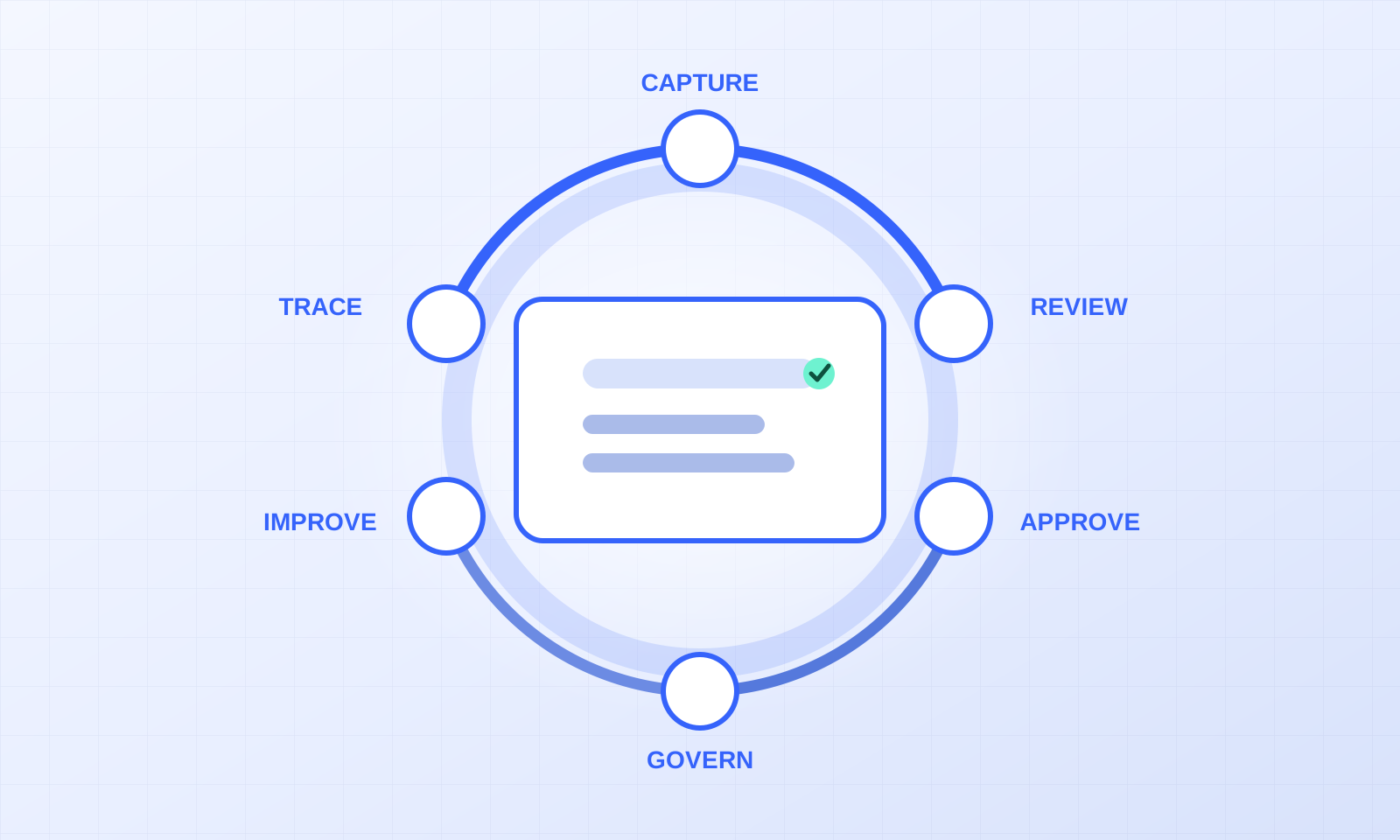
NewBizLabs helps product and engineering organizations scale with a stronger compliance posture and less delivery drag by designing security, privacy, auditability, and AI governance into the way teams work.
Read moreTell us where you need leverage, from strategy and architecture to production and adoption. We'll help define the right next steps.
Contact us