Engineering effectiveness
Workable controls and ownership patterns that support faster, healthier delivery
COMPLIANCE-BY-DESIGN OPERATING MODEL
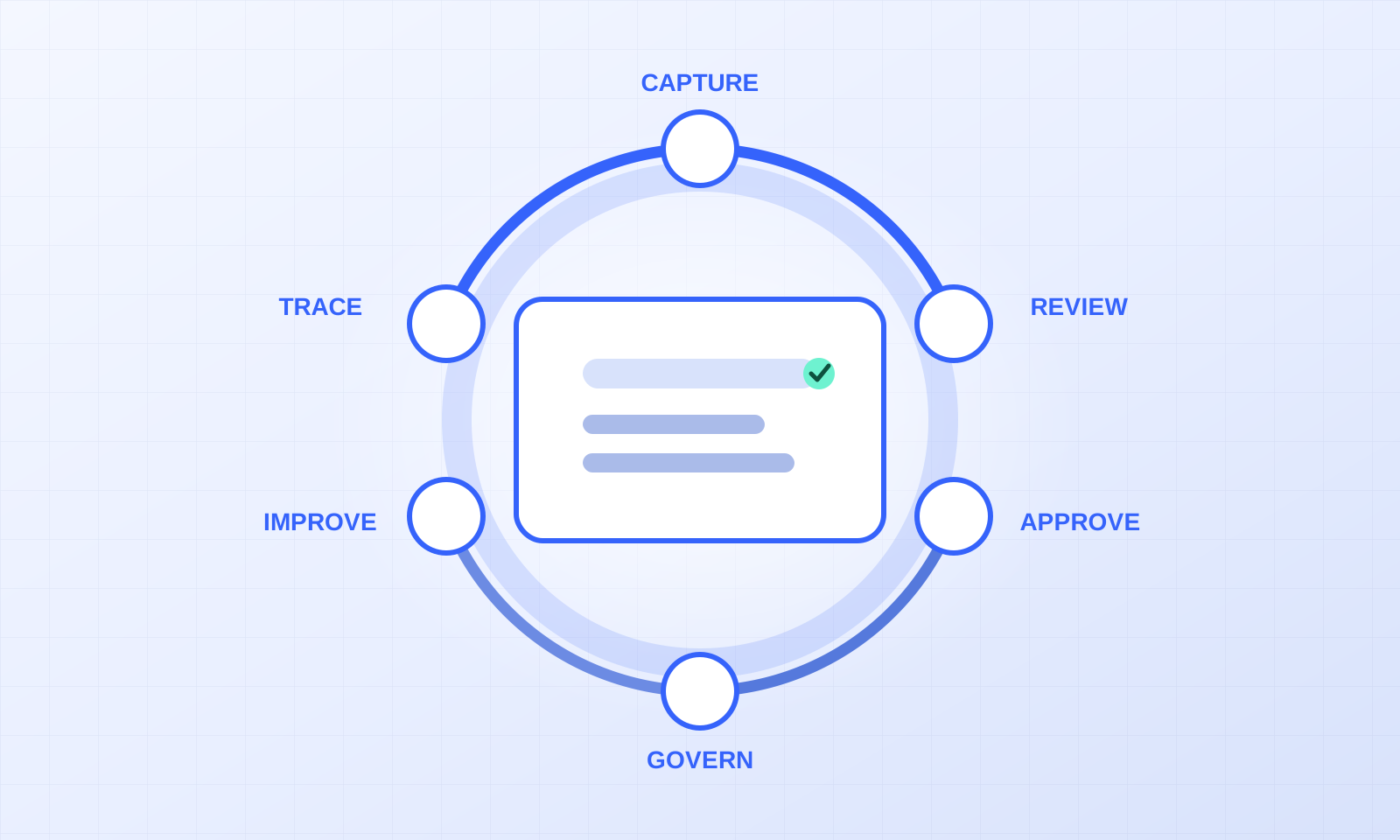
Engineering effectiveness
Workable controls and ownership patterns that support faster, healthier delivery
Security, privacy, and auditability
Stronger evidence flow and delivery discipline built into day-to-day execution
AI governance
Governance expectations extended into AI and ML systems without added bureaucracy
As product and engineering organizations grow, security, privacy, auditability, and AI governance expectations often outpace the way software is planned, reviewed, and shipped. NewBizLabs addresses that mismatch with clearer decision rights, tighter control boundaries, and engineering practices teams can sustain under pressure.
"Organizations scale better when security, privacy, auditability, and AI governance are built into the way teams work early enough to strengthen posture without creating extra drag."
Operating perspective
Ambiguity sits at the heart of most challenges. Requirements shift, frameworks overlap, and teams lack a practical definition of what good looks like inside everyday product and engineering work.
That ambiguity often turns into friction once security, privacy, auditability, and AI expectations are interpreted late in the lifecycle, after key product and engineering decisions are already in motion.
Approvals and control responsibilities often cut awkwardly across product, engineering, security, legal, and compliance, which slows decisions and leaves patchy records behind each change.
Cross-functional alignment is necessary, but it is not enough on its own. Without better workflow design, teams remain exposed to rework, escalation loops, and avoidable slowdowns.
NewBizLabs changes the way teams work by moving control intent into planning, development, review, release, and operational routines instead of leaving it to late-stage process. The focus stays on clear handoffs, practical responsibilities, and controls teams can keep using when timelines tighten.
Workflows are redesigned to support secure change, cleaner audit trails, and better auditability without turning engineering into process theater. That makes expectations easier to apply across the lifecycle as pressures such as SOC 2 Type II and SOX become more material.
Privacy and accountability requirements are translated into concrete boundaries around change and access where obligations such as GDPR and HIPAA require them. The same pattern extends into AI and ML systems through practical controls, including ML observability, interpretability, explainability, and readiness for evolving EU AI Act expectations.
Audit-ready controls
SOC 2 Type II and SOX-aligned control design, evidence flow, and change discipline
Privacy-safe delivery
GDPR and HIPAA-aware boundaries for access, data handling, and accountability
Responsible AI readiness
EU AI Act readiness supported by ML observability, interpretability, and explainability by design
Teams gain clearer control responsibilities and decision paths, which reduces escalation overhead and makes product and engineering work easier to move forward.
Audit readiness improves because records, change discipline, and review expectations are built into execution instead of reconstructed through late-stage scrambling.
Security and compliance bottlenecks ease as organizations move from reactive fixes toward a more coherent way of working with less rework and healthier engineering adoption.
AI governance becomes easier to strengthen without adding drag because it is built into the same routines rather than treated as a separate bureaucracy.
The hard part is not writing down control language. It is turning shifting requirements into practical controls teams can use every day without degrading speed or developer experience.
The design problem sits at the intersection of changing control expectations and practical engineering constraints. Organizations need an approach that can stand up to audit, privacy, accountability, and AI-risk pressure while still fitting real planning, development, release, and operational rhythms.
Requirements are rarely stable or neatly scoped, and the controls themselves cut across multiple teams. The design therefore has to reduce ambiguity, preserve usable responsibilities, and stay adoptable for engineers even when timelines tighten.
The design is built around concrete control points inside the software lifecycle rather than around standalone policy artifacts. Threat modeling, change management, access review, environment boundaries, and audit trails are anchored to day-to-day execution so responsibilities stay visible and secure change becomes easier to sustain.
For AI and ML systems, the same design extends into ML observability, interpretability, explainability, and governance controls that support evolving EU AI Act readiness without isolating AI risk from the rest of engineering operations. The result is a more durable set of workflows and accountability patterns that strengthen posture while remaining usable under real conditions.
"The real value is not a thicker layer of compliance process. It is an engineering system with clearer responsibilities, more reliable audit trails, and workflows that can keep holding up as requirements evolve."
Operating perspective

Privacy-first ESG platform engagement combining regulatory rigor, scalable AI platform architecture, and human-supervised agentic workflows for audit-ready GHG accounting.
Read more
AI decisioning platform powered by reinforcement learning and built for real enterprise use cases.
Read moreTell us where you need leverage, from strategy and architecture to production and adoption. We'll help define the right next steps.
Contact us